Restoring a Classic: Why the Bodywork Comes Before the Paint
A good paint job over bad bodywork just makes the dents easier to see. Here's the order that actually works.
September 2, 2026 · 3 min read
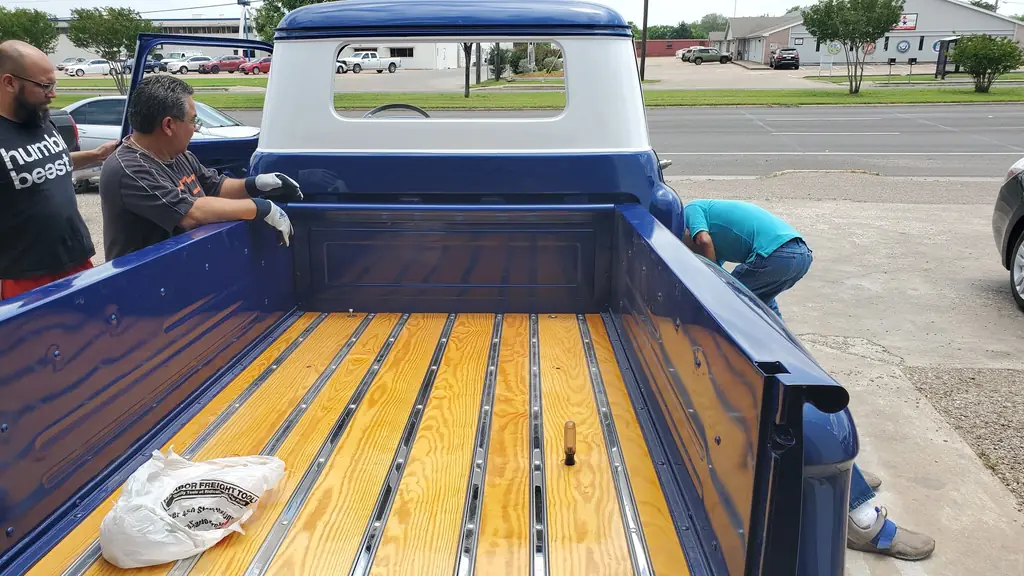
Park a fresh coat of gloss paint over a wavy panel and you haven't fixed anything. You've made the wave shinier and easier to see, especially under direct light, which is most of the light Texas has to offer. That's the whole argument for why bodywork comes before paint, and it's the order Edward's followed on the truck that's become something of a calling card for the shop: a deep-blue, two-tone mid-1950s Chevrolet 3100 stepside pickup.
Start with what's actually there, not what you wish was there
Before any restoration starts, the truck gets stripped down enough to see the real condition of the metal underneath, not just the paint hiding it. Fifty-plus-year-old trucks have usually lived a few lives by the time they land in a shop bay: some rust, some prior repairs of varying quality, occasionally structural work that needs redoing before anything cosmetic happens at all.
Bodywork, panel by panel
This is the slow part, and it's the part that actually determines whether the finished truck looks restored or just repainted. Every panel gets straightened, filled where it needs filling, and blocked down flat before it ever sees primer. On a two-tone truck like the 3100, this matters even more, because the line between the two colors runs straight along a body crease. If that crease isn't straight, the color break won't be either, and there's no amount of paint that fixes a crooked line after the fact.
The wood and chrome are their own project
On a stepside like this one, the bed floor is wood, not sheet metal, fitted with polished chrome strips down each side. That's carpentry and metal finishing as much as it is auto body work, and it runs on its own timeline, separate from whatever's happening to the cab.
Then, and only then, paint
Once the metal is straight and the surface is right, the truck goes to paint under the same guarantee Edward's runs on every collision repair that comes through the door: matched, and matched to hold up, not just to look good on delivery day. On a two-tone job, that means two colors that both have to be right, plus a break line that stays sharp instead of feathering into a blur six months later.
How to tell if something's actually worth restoring
Not every old truck sitting in a barn is a good candidate, and it's worth being honest about that before falling in love with a project. The frame and structural metal matter more than the cosmetics. Surface rust on body panels is usually fixable. Rust that's eaten through the frame rails, the floor pans, or the areas around suspension mounts is a different conversation, one about whether the vehicle is a restoration or a parts donor. A truck like the shop's own 3100 was worth the time because the bones underneath the dents and old paint were solid enough to build on. That's the actual question worth answering first, before a single panel gets stripped.
Why a restoration takes longer than a repair
A collision repair is fixing what a specific impact did to a specific area. A restoration is re-examining the entire vehicle, panel by panel, because there's no single point of damage to work from, just decades of ordinary wear, old repairs of unknown quality, and whatever the previous owners did or didn't maintain. That's a fundamentally slower process, and it's supposed to be. Rushing a restoration produces exactly the outcome bodywork-before-paint is meant to prevent: a truck that looks right in photos and shows every flaw the moment it's parked under real sunlight.
This isn't only trucks
The same order applies to whatever else rolls into the restoration side of the shop: classic cars, vintage motorcycles, bikes, general bodywork on anything old enough to need it. A motorcycle tank has its own version of the same problem, small dents and old dings that telegraph straight through a fresh coat if the metal underneath isn't actually flat first. The scale changes, the principle doesn't. The metal work comes first every time, because paint was never going to be the thing that fixed a wave in a fifty-year-old fender or tank.
The finished 3100 went home on a flatbed down La Salle Avenue with the Texas flag flying behind it, which is about as Waco an ending as a truck restoration gets. If there's something with more decades on it than miles sitting under a tarp in your garage, that's the kind of job this shop actually likes taking on.
Edward's Auto Paint Shop — (254) 752-8819
Call (254) 752-8819More articles
What Actually Happens Between a Wreck and Getting Your Car Back
No jargon, no guessing. Here's the order things actually happen in, start to finish.
Why Matching Your Paint Color Is Harder Than It Looks
Two cans of "the same" color can look nothing alike once they're on the car. Here's why.