Why Matching Your Paint Color Is Harder Than It Looks
Two cans of "the same" color can look nothing alike once they're on the car. Here's why.
September 2, 2026 · 3 min read
Paint color sounds like it should be simple. Your car has a paint code, the code has a formula, the formula gets mixed and sprayed. In practice it's a lot less simple than that, and if you've ever seen a repaired panel that's just slightly off, not wrong, just off, you've already seen why.
The paint code is a starting point, not an answer
Every car left the factory with a specific formula, and that formula is a fine place to start. But the paint on your car isn't factory-fresh anymore. It's been through however many Texas summers you've owned it, and Texas summers do things to paint a formula sheet can't predict. UV breaks down pigment unevenly across a car, so the hood, which takes the most direct sun, can fade differently than the door panel right next to it. Match the formula exactly and you can still end up with a repaired panel that's technically correct and visibly wrong next to the sun-faded paint around it.
Metallics move
If your car has a metallic or pearl finish, there's another layer to it. Metallic paint has tiny flakes suspended in it, and how those flakes catch the light depends on how the paint was sprayed, how thick the clear coat went on, even the angle of the gun. Two shops using the exact same paint code can produce panels that look different sitting side by side, because flake orientation was never part of the formula. It's technique.
That's why blending exists
A good shop doesn't stop the new paint at a hard edge where the old panel meets the new one. The color gets feathered out onto the adjacent panels too, so there's no line for your eye to catch. It's more work and more material for the same job, but it's the difference between "you can't tell it was ever damaged," which is what more than one review on Edward's Google listing actually says, and a repair you can spot from across the parking lot.
Sometimes there's no formula at all
Custom colors, older cars, and restorations don't always have a code to pull from in the first place. This comes up constantly on Edward's restoration work, where a fifty-year-old truck or motorcycle might be wearing a color nobody's mixed in decades. That's where a special color gets mixed from scratch instead of pulled off a shelf, matched by eye and by sample against a chip of the real thing until it's right, not just close.
Gloss and texture matter as much as hue
Color isn't only about hue, either. A panel can be the right shade and still look wrong if the surface underneath the clear coat isn't as smooth as the factory finish next to it, or if the clear itself has more or less orange peel, the faint texture you can see if you look at a painted panel at a low angle. Getting the hue right and getting the surface right are two separate jobs, and a shop that only nails one of them ends up with a repair that photographs fine and still looks off in person, which is exactly the gap most people can't put a finger on but notice anyway.
Restoration work raises the stakes
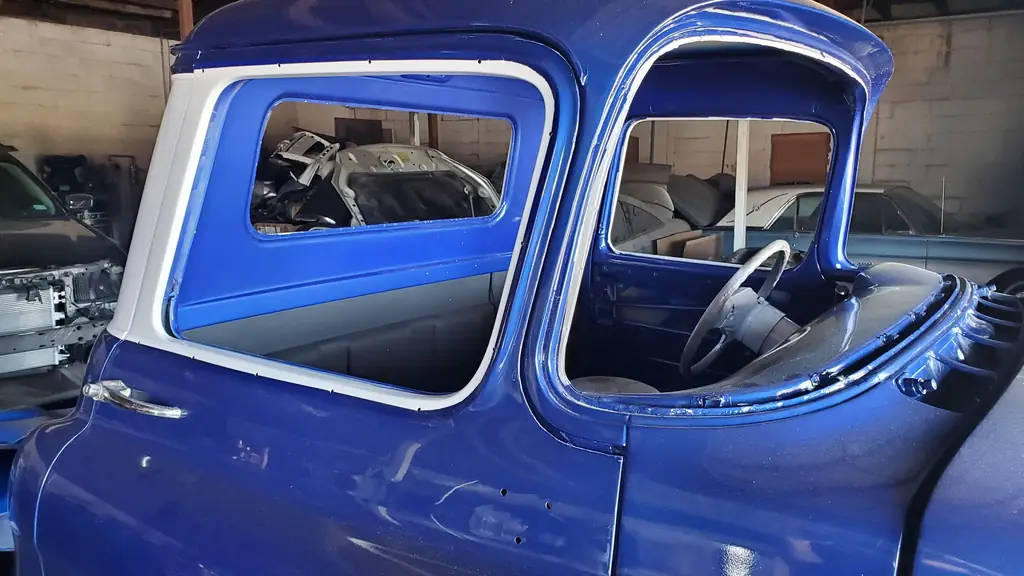
All of this gets harder, not easier, on restoration jobs. The deep-blue two-tone 1955 Chevy 3100 that's become something of a calling card for the shop needed a color that hasn't come off a factory line in seventy years, mixed and matched across two separate tones that both had to hold their own against each other on the same truck. There's no sun-fade reference panel to check against on a truck like that, no factory sample to hold up next to the mix. It's judged entirely by eye, against photos, memory, and whatever original paint chips can still be found under a trim piece or inside a door jamb.
What "guaranteed" actually means here
Edward's backs its work with a color match guarantee and offers free estimates on all auto body work, which is another way of saying they're not going to hand you a car and hope you don't look too closely at it in the sun. If it doesn't match, that's on them to fix, not on you to live with for the next five years of ownership.
There's a reason a handful of separate strangers have all left roughly the same review: you can't tell it was ever damaged. That's not luck. That's someone actually doing the blending instead of stopping at the first coat that's close enough.
Edward's Auto Paint Shop — (254) 752-8819
Call (254) 752-8819More articles
What Actually Happens Between a Wreck and Getting Your Car Back
No jargon, no guessing. Here's the order things actually happen in, start to finish.
The First Hour After a Wreck in Waco: What to Actually Do
You don't need to remember much. You need to remember this, roughly in order.